
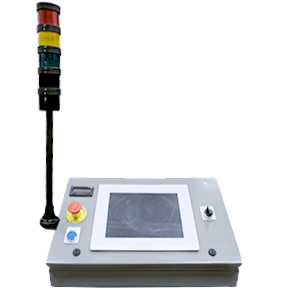
Operator consoles provide a centralized interface for controlling and monitoring machines or process equipment. These consoles are typically fitted with buttons, indicator lights, HMIs, meters, and other operator‑interface devices that allow continuous monitoring and adjustment of system functions. Control Innovations supplies operator consoles ranging from simple control stations to fully enclosed operator cabins.
Operator consoles give personnel direct access to machine controls and real‑time system information. They serve as the primary interface for starting, stopping, adjusting, and supervising equipment, allowing operators to manage processes efficiently and safely from a dedicated control point.
Key Capabilities
Control Innovations operator consoles typically support:
- Pushbuttons, selector switches, and emergency stops
- Indicator lights and status displays
- Human‑machine interfaces (HMIs) for advanced control and visualization
- Meters and gauges for continuous monitoring
- Integrated PLC or relay logic when required
- Local or remote operation modes
This provides a flexible and intuitive control platform for a wide range of equipment.
Console Types
Operator consoles can be configured in several formats, including:
- Stand‑alone operator stations with mounted controls
- Panel‑mounted consoles attached directly to machinery
- Pedestal‑mounted consoles for ergonomic access
- Full operator cabins that house the operator and all control equipment
- Custom enclosures designed for specific equipment layouts
This allows the console to match the physical and operational needs of the application.
Construction & Components
A typical operator console may include:
- HMIs or touchscreen displays
- Pushbuttons, switches, and joysticks
- Meters, gauges, and annunciators
- Power distribution and protective devices
- Terminal blocks and wiring for field connections
- Enclosures rated for indoor, outdoor, or industrial environments
This ensures durability and clear visibility of machine status.
Applications
Operator consoles are commonly used in:
- Industrial machinery
- Material‑handling systems
- Process equipment
- Packaging and assembly lines
- Cranes, hoists, and mobile equipment
- Custom OEM systems
They provide a dependable interface wherever operators need direct, continuous control of equipment.